Most responses to civilizational crisis look outward—toward policy, energy systems, geopolitical players, and the flow of materials—while paying little attention to how the people inside those systems might themselves change and grow. Yet the same minds that built this fragile, intricate world are the very instruments we’ll have to rely on as it comes apart, which makes our inner development a decisive factor in shaping humanity’s future. So the question stands: who will we become as simplification arrives, and how do we ready our inner landscapes for what lies ahead?
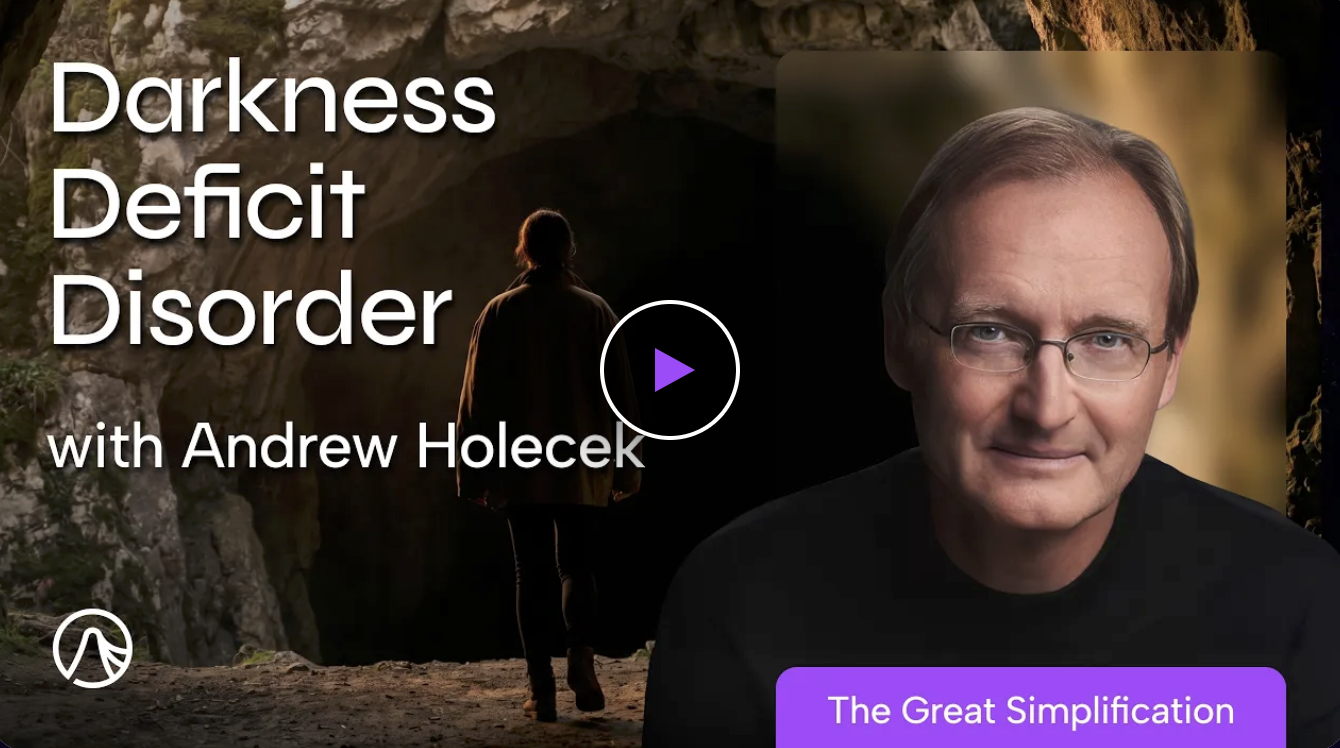
In this episode, Nate is joined by Andrew for a conversation about dark retreat—extended stretches of time spent in total darkness—as a practical route toward reflection and reconnection, both with ourselves and with one another. Drawing on decades immersed in Tibetan Buddhism and non-dual wisdom traditions, Andrew examines how the outer complexity of modern life is echoed in the inner complexity of the modern mind. At the heart of his work sits non-duality: a movement away from the fractured drama of self-against-world and toward a more unified, less suffering-bound relationship with reality. Andrew and Nate also unpack the false link between happiness and consumption, making the case that contentment comes not from getting what we crave, but from the quieting of craving itself.
What might it mean to practice darkness as a welcome reprieve from relentless light and stimulation, rather than as deprivation? If the decades ahead bring a forced contraction of external, material complexity, how might a deepening of our inner worlds leave us more resilient, compassionate, and grounded? And could facing fear directly—learning to move through it instead of around it—turn out to be one of the most practical preparations for the uncertainty and social fracture still to come?